skip to main |
skip to sidebar
We've reached a milestone! Urban Sprouts has just finished a three-year funding cycle with the Network for a Healthy California's Local Food and Nutrition Education channel. Phew!
We've grown and matured so much during these three years - from a mostly-volunteer staff of one, to a strong team of five serving 7 schools and over 700 youth every year. We've learned that valuing our school partners and cultivating youth leadership help us to do our best. We've worked to grow and expand while staying true to our vision, of quality and consistent programs, but tailored to the needs of unique communities.
Please see for yourself! Lisa Chen on our Advisory Board and Adriani Leon on our staff created this presentation with me and we presented it in Los Angeles a few weeks ago. Take a look!
AND you MUST read this colorful, graphic and fun short handout that summarizes who we are and what we've done in our five years of school gardening! Created by Lisa Chen.
 Tomorrow at the 2009 Childhood Obesity Conference in LA, I'll be presenting on Urban Sprouts' program model for garden-based education and our recent evaluation results!
This work is a partnership with Portland, Oregon's Ecotrust, and also shows off their accomplishments in Farm to School and creating locally grown and produced school lunches.
If you'd like to see the slides and download the handout of the model, follow this link.
Also check out these California resources on School Gardens and Farm to School.
Tomorrow I'll be presenting on Urban Sprouts' Garden-based Education Model — the theoretical framework that guides all our programs — at the Network for a Healthy California's annual conference. I'll also give an overview of our results from our 2006-2008 Program Evaluation. You can look through my slides, below. They make a lot more sense with my narration, which I will try to record and post soon.
If you've already seen the presentation, these slides will be a helpful reminder of what we discussed. Also, check all my posts tagged gbemodel for more and click here to see an image of the full Model. Enjoy!
Enjoy this excerpt from our recent Garden Brunch event, of a speech that laid out the past, present and future plans for Urban Sprouts' work.
Our Early Days to Now
This year, Urban Sprouts has worked with over 700 students, and supported school garden programs at six middle and high schools in San Francisco’s under-served neighborhoods.
The seeds of Urban Sprouts were sown five years ago, when educator Dr. Michelle Ratcliffe conducted her dissertation research on the benefits of school gardens at three middle schools in San Francisco. When I look back to 2003, it’s amazing to realize how far we’ve come. At Luther Burbank Middle School, we encountered a few solitary teachers striving to build a garden in a bleak and neglected school by scrapping together any resources they could find. Today, Urban Sprouts partners with six schools with thriving gardens, and the Obamas are planting vegetables on the White House lawn. Times have changed.
First, I’d like to share with you some of the ways that school gardens are so transformative for youth, families, schools and communities. I’m sure you’re aware of how much the obesity epidemic affects young people, even here in San Francisco. We hear from many youth in our programs that preparing meals from food they grew themselves dramatically improves their attitudes towards healthy foods and helps them make real changes in their eating habits. When students were asked about their eating habits in focus groups last year, in 78% of responses students said they eat more fruits and vegetables than before, and in 92% of responses they said they try to eat more healthy foods and less unhealthy foods. Some examples:
“I want to be eating more greens EVERYDAY, and less sugar. I plan on sharing my knowledge about nutrition with my parents and brother.”
“The garden helps you do better in school because it keeps you healthy.”
“I do better in school now because my body is not being energized with Cheetos, it’s being energized with lettuce!”
Also, by nurturing living things in the diverse garden ecosystem students also develop their desire to protect the environment. When students were asked about the environment in focus groups last year, in 53% of responses students said they care or worry about the environment more than they did before. Some examples:
“I’m worried more about pollution because we depend on nature to survive, to grow our food, our vegetables, and trees to breathe.”
“I plan to teach my family more about soil health, and how our health relates to the world's health.”
“I want to recycle more and compost instead of put it into the landfill.”
And my favorite quote of all:
“In the garden, I learned to grow up and be a successful person.”
So you see, school gardens can be life-changing for young people. But, there’s one catch. Not just any school garden will bring about these inspiring changes. What we do in the garden with youth matters.
That’s why Urban Sprouts’ school garden programs are different. We are guided by a research-based “recipe for success” that enables our school gardens to achieve big results. Dr. Michelle Ratcliffe has developed her dissertation research into a guiding framework for garden-based education. In other words, we’re not only measuring the outcomes or results of our program, we are measuring the “inputs,” making sure that every young person gets the highest quality education in the school garden.
Our Shared Future
We’ve gathered you all here at a time when economic crisis affects us all, whether you or your loved ones have experienced job loss, retirement dreams cut short, or belt-tightening in the household budget, even affecting your day to day food choices. Today, as we look for hope, comfort and meaning, we have a great opportunity to share the power in the simple act of gardening. Victory Gardens kept our country healthy and hopeful during early 20th century wartime and Depression, and our children grew 40% of our country’s produce right in their own school gardens.
With this inspiration, this year Urban Sprouts has launched a brand new program, our Family Farmers-in-Residence program. We’ll provide school families with resources and support to plant their own food gardens right on school grounds. The Farmers-in-Residence share their cultural crops and recipes with peers and grow fresh food to feed their own families. This spring, five family teams including moms, dads, grandmothers and children, have broken ground on their family garden plots.
School gardens can also drive the demand for food grown by local and sustainable farms, as we develop a committed base of consumers. Local agriculture creates jobs and puts money in regular people’s pockets, a true local stimulus package. Our neighbors to the north, in Oregon and Washington, are creating policies that turn their public schools into engines of economic growth, as a huge market for local farm produce. By planting home gardens and spreading the word about supporting local farms, we can keep our families healthy and sow the seeds of a sustainable future.
Urban Sprouts brings this message to youth and their families in San Francisco’s working neighborhoods, investing in the next generation of green consumers, green voters, and the green collar economy.
Now, we want to share our message and our successful methods with more youth, teachers, and communities. In the coming year, we will step forward as leaders in this movement. We’ll take our show on the road, providing a series of trainings with in-depth follow-up coaching for schools and community leaders all over California and the West. We’re making plans with partners from LA to Seattle, in urban food deserts where no grocery stores exist for miles, and in Central Valley communities that ‘export’ vegetables to feed our nation but leave their own residents hungry in a rural food desert. By sharing our experiences and learning from our neighbors, we can strengthen this healthy food movement at the grassroots level, outside the Bay Area bubble.
But you know what, there’s something else that makes Urban Sprouts special. It’s the reason we’ve invited you all here today, to get to know us in person. People like us, who take a stand for our beliefs and work tirelessly to lead and organize in our communities, we often feel loneliness and burnout even as we achieve victories in our work. As we step up our leadership and broaden our reach, Urban Sprouts is planning for not only the sustainability of our programs but the personal sustainability of our leaders and members. Through careful planning, we’ll ensure that our staff feel supported, we’ll collaborate to share our increasing workload, and we’ll continue to provide living wages and health benefits to all staff. With your investment, we will step forward as leaders in this movement, sharing our methods, our vision, and our integrity. Your partnership will make all the difference.
Thank you very much.
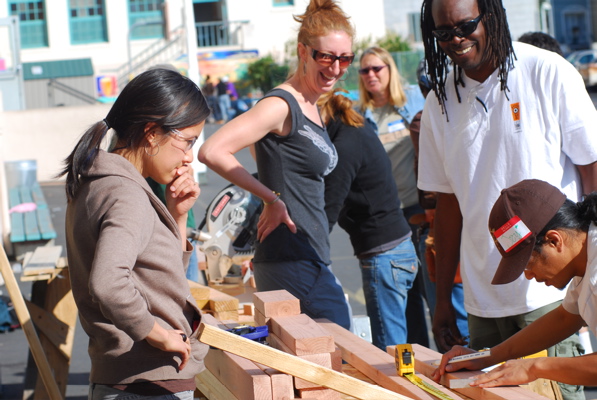
 Urban Sprouts was proud to be part of the San Francisco Green Schoolyard Alliance's 3rd Conference on October 10th-11th. The weekend was like a party for the school garden movement — new things to learn (photos at right and below), like cob building, mosaics, carpentry, and seed saving, and time to spend with old and new friends inspired by our shared mission!
 Friday night we heard speaker Richard Louv, who gave us one great pep talk about how our work is changing the world! Louv's book, Last Child in the Woods, describes how youth are suffering psychologically from a lack of connection to nature, which he names nature-deficit disorder.
 Louv gave us many powerful examples of how school gardens change lives. He told us that experiences in nature are therapeutic for children with hyperactivity disorders and depression, and they develop executive functioning (self-regulation or self-discipline) in kids. He described studies showing that paved schoolyards bring out aggressive games and leadership styles, namely bullying, while natural play settings bring out imaginative play and creative and collaborative leadership in children. In fact, unstructured nature-based play is so good for children, Louv recommended it as the best way to get your child to a top college. Wow! There wasn't a dry eye in the place.
On Saturday, I led a workshop titled, The Real Impacts of School Gardens: How to Make Change and Measure It. I had 3 whole hours — enough time to lead the group through our Garden-based Education Model in depth, to really understand the model and try it out on their own programs. I had enough time to create a nice flow during the workshop, complete with group games, reflection, and drawing activities! It was a great group and we all learned a lot from each other.
The response to Louv's work and the popularity of my workshop showed how much the school garden movement has matured. We are not just building school gardens because they are nice, pretty, and make kids happy. We are creating major social change. In the last few years, we have shown that school gardens impact children individually — developing children socially and psychologically, helping them succeed in school, and changing their behaviors as they eat more vegetables, exercise more, and become environmental stewards.
But, now we are seeing that school gardens do much, much more. They transform schools from their prison-yard look to a green and inviting environment, drawing families in, to make schools stronger. They make our neighborhoods cleaner, greener and friendlier. AND, school gardens teach our children to be our nation's future farmers. Our youth will enter the green collar economy in a few years, in a world where we will have been forced to design a new food system that is not dependent on fossil fuels. Our children will be growing and consuming local food, right here in our neighborhoods. And you saw it here first, in San Francisco's own schoolyards!
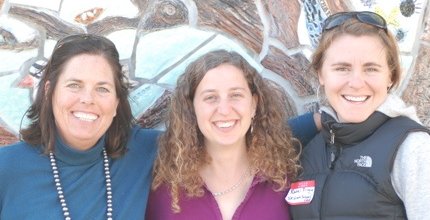
 Above: SGFSA Conference organziers, Arden, Sharon & Rachel
Photos by Jennifer Thacher
Outcomes and Activities:
During the 2007-2008 school year, Urban Sprouts planned to reach 500 students in the 6th through 12th grades at five San Francisco public schools serving the city’s most under-served neighborhoods.
 Urban Sprouts greatly surpassed this goal, reaching a total of 728 students this year. Urban Sprouts partnered with five schools: Aptos Middle School, Excelsior Middle School, Martin Luther King Jr. Academic Middle School, June Jordan School for Equity, and Ida B. Wells Continuation High School. These schools serve San Francisco neighborhoods including the OMI/Excelsior, Sunnydale, Visitacion Valley, Portola, Bayview-Hunters Point, and Western Addition. Of students reached, 64% were low-income students, 96% were youth of color, and 52% were defined as educationally disadvantaged by the San Francisco Unified School District.
We provided the following activities at our five school sites:
In class Garden-based Education. Over 688 students participated in Urban Sprouts’ core garden-based education  program that takes place during science classes. The garden-based classes meet for one hour every other week throughout the school year for a total of 20 hours of participation for every student. Each session is led by the Garden Educator and includes interactive academic learning and garden work. Every student experienced the full process of planting, growing, harvesting and eating crops from the school garden at least three times during the school year. By participating in the entire process, students have strengthened their ecoliteracy and environmental responsibility.
An additional 18 high school students at June Jordan School for Equity participated in a semester-long elective course focused entirely on sustainable agriculture and food production. This garden-based curriculum included weekly lessons that took place in the school garden, curriculum on nutrition, food production, distribution and marketing, food policy, farm economics, and the environmental impact of agriculture, as well as a farm field trip to Hidden Villa Ranch in Los Altos, California.
Garden-based Youth Leadership. We partnered with teachers and students to identify leadership opportunities for smaller groups of students, to engage more intensively with the garden and to lead related school-wide activities. These opportunities involved 15 students:
- Excelsior Middle School: Seven students in Urban Sprouts’ after school program created, implemented and evaluated a school-wide recycling program. Students led a waste diversion campaign that included posters, monitoring recycling bins at lunch, and calculating the school’s waste diversion percentage, with support from San Francisco’s Department of the Environment.
- Martin Luther King, Jr. Middle School: Eight students in Urban Sprouts’ after school Garden Club conducted an Earth Day awareness campaign. Students from all of MLK’s 6th and 7th grade classes decorated paper shopping bags with messages about Earth Day and about reusing and recycling waste materials. The after school Garden Club brought the bags to a local supermarket on Earth Day and gave them out to shoppers to reuse for their shopping.
 Summer Program. For the second summer, Urban Sprouts partnered with the Garden for the Environment (GFE) to host a two-week summer program for 21 youth, meeting for four hours each day at the GFE. Urban Sprouts trained and supervised 5 high school students who served as staff for the 16 middle school-aged participants. The Summer Program included: daily garden work; an intensive curriculum on gardening, waste diversion, nutrition and sustainable agriculture; daily harvest and preparation of a healthy lunch, and the creation of a culminating event in which youth shared their learning with their families and friends and created take-home actions to apply their learning at home (examples included kits for home recycling, composting, and gardening).
 Family Programming. Our school partners identified increased parent engagement as a major goal, and
  encouraged Urban Sprouts to utilize the school garden for this purpose. In addition, changes in youth attitudes and behaviors of environmental responsibility achieve greater impact with parent support and reinforcement at home. Urban Sprouts participated in three school-wide events for parents and held twelve meetings and workshops, engaging 63 school parents with the school garden and with cooking projects using garden-grown produce.
Due to feedback from school parents, we are redesigning the format of this program. During the next school year, family programming will include family garden plots within school gardens, in which families will showcase cultural gardening practices while producing food for their own consumption. The new garden plots will be installed in October 2008 with support from Clif Bar.
School Farm and Food Connection.  In order to connect the school community to local farms and healthy food options, Urban Sprouts took four groups of students on farm field trips to Hidden Villa Ranch in Los Altos, California and to Slide Ranch in Muir Beach, California. In addition, we helped students and parents at Excelsior Middle School to design and practice preparing healthy meals made from fresh produce, so the group could prepare these meals while traveling on a school field trip to Washington, DC. Lastly, Urban Sprouts participated in efforts to revise the SFUSD Wellness Policy through the Student Nutrition and Physical Activity Committee, in order to continually increase opportunities for students district-wide to improve their health, wellness and the environmental impact of their schools.
Events. During the 2007-08 school year, Urban Sprouts hosted these community-wide events to build involvement in the garden program:
- Salad Days: students at all three middle schools harvested, prepared and served school-grown salads to the entire school at lunch;
- Garden Work Parties: students and staff at each school site hosted garden work days, including gardening, harvesting, cooking, and other activities, attended by students, families, teachers and community members.
Volunteers. Urban Sprouts recruited community members to develop and maintain the gardens through work days, and to volunteer in teachers’ classrooms during garden-based lessons. Classroom volunteers lowered the youth-adult ratio from as high as 35:1 to as low as 5:1. In total, 22 volunteers provided over 400 hours of support to students in the school garden, while 110 volunteers including employee groups from Act Now, Clif Bar, Skywire, Sutter Health, and Google contributed 440 hours helping to build wheelchair-accessible garden beds, worm bins, and a new chicken coop in the garden.
 Evaluation and Outcomes:
Each year, Urban Sprouts conducts surveys and focus groups to determine the degree of students’ new knowledge, attitudes and behaviors after participating in our programs. Urban Sprouts’ objectives include increases in students’ ecoliteracy, environmental awareness and preferences for consuming fruits and vegetables as a result of participating in our programs.
 This year, Urban Sprouts implemented an online pre- and post-test survey questionnaire, student focus groups and key informant interviews. This data is currently being analyzed by Urban Sprouts’ Evaluation Specialist, Michelle M. Ratcliffe, Ph.D. We will share our results on our website as soon as they are complete.
Currently, we have results of Urban Sprouts’ program evaluation conducted by Dr. Ratcliffe from 2004 to 2006 in our middle school programs. We have exciting results to share. Urban Sprouts’ evaluation showed that the garden-based learning experiences:
- Influenced the school’s curricular, physical and social learning environments.
- Affected students’ environment-related skills and knowledge, and attitudes and preferences towards the environment.
- Provided opportunities for students to begin to make sense of the natural world and their relationship to it.
- Influenced students’ social and moral development including strengthening their resiliency traits of pride, patience, hard work, team work, and motivation.
- Influenced students’ willingness to try new foods, decreased their consumption of less nutritious foods, and increased their physical activity level.
- Participating students increased their preferences for a variety of vegetables, the variety of vegetables they eat and how often they eat them.
 I recently got back from a weekend trip to Philadelphia. Christine Manoux of the UC Botanical Garden asked me to join her for a conference at the Franklin Institute. The Franklin's BRIDGES conference asks about 50 cultural institutions from around the country — like science museums, children's museums, zoos — to bring a community partner and share how they work together to make the museums more accessible and exciting for new audiences, like the families we serve.
Christine and I presented on our shared work of supporting school gardens in the Bay Area, and I was excited about the idea of connecting families more to our botanical gardens. What better way to get inspiration for your home garden? Botanical gardens can be a fun and educational way to connect families to the garden-based education we're doing at schools. Thinking back . . . that was always one of my dad's first stops in any new place!
The format of the conference was very interesting - it was like a giant focus group to gather best practices on making museums accessible to more families. I loved what folks from the American Museum of Natural History in New York said, about empowering the youth in their programs to explore the museum, equipped with flashlights and the gear of scientists, so THEY feel like the experts and like they belong in the very grand museum. Folks from the Boston Children's Museum shared about exhibits created not by white-scientist-experts, but by members of the city's immigrant community, to share stories and history from the city's diverse voices. I know I am often turned off by museums presenting generalized archeological information about a culture as if all its members were the same and all now dead.
A very thought-provoking conference, including a visit to the Real Pirates exhibit at the Franklin. So much fun! I highly recommend it. We also enjoyed our time in Philadelphia, a truly beautiful, historic and fun city! Go there, if you can!
 I was extremely honored to be asked to give the keynote speech at last Saturday's School Garden conference held by the UC Botanical Garden at Berkeley. The conference theme was successes and best practices, so I shared the Program Model and the story of how Michelle's research study on school gardens led to this framework that guides all Urban Sprouts' work. If you haven't yet visited this amazing botanical garden, go now!
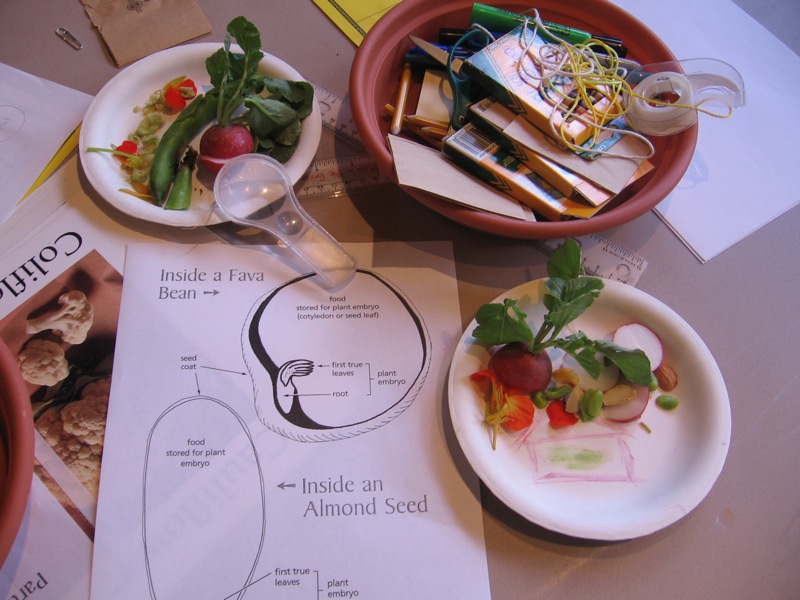
 Presentations at the conference included the Botanical Garden's Botany on your Plate curriculum, which you can now buy at their bookstore. We explored plant parts, and found that you can use radishes as giant pink crayons! We made root mash (like mashed potatoes) from six different root vegetables, and the most popular one was rutabagas!! Apparently rutabagas are becoming endangered because not enough people eat them. I found them delicious.
 In my talk, I also brought up the history of school gardens in the US. Too few of us garden educators know our own history - that during World War I and II school gardens were identified as a major solution to the social issue of the day, national security.
Wartime threatened our food supply, and even Europe was dependent on US-grown food. The US School Garden Army enlisted "soldiers of the soil" to grow food at schools, to increase fruit and vegetable consumption, and to improve the health of the populace. This call that "food will win the war," was incredibly successful. Several million school children grew food in their school gardens, growing 40% of all fruits and vegetables eaten in the US. This was the time in our history when Americans ate the most fruits and vegetables, ever! I learned all this from Rose Hayden-Smith's fascinating work on the US School Garden Army. On her website you can see some of the old propaganda posters, including the one above, calling on children to serve their country in the school garden!
Think we can create such a mass mobilization today? School gardens can have a major impact on many current issues, beyond getting kids to eat more veggies and do better on standardized tests. Can you think big, and think of ways school gardens can make real change in our communities?
A few weeks back I gave a presentation at the Network for a Healthy California Annual Conference in Sacramento. It was a chance to share with other nutrition educators a special strength of Urban Sprouts -- our "Model," something that has theory behind it, has been tested by research, and guides everything that we do. Why is this so special? Let me share a couple of the reasons why we use a program model.
- Not guessing what works – existing theory and the body of knowledge from multiple fields inform our work.
- A recipe for success – what ingredients we must add in order to get the outcomes we desire.
- Evidence of outcomes – Inputs and outcomes are tested by research and evaluation to show impact in the real world.
- A Measurement tool – The model guides all our practices, shows how well we’re doing, and tells us where to make improvements at every step.
Now, you may be wondering, what does this really mean, to have a program model?
Urban Sprouts’ program model was created by Dr. Michelle Ratcliffe. In fact, Dr. Ratcliffe's doctoral research project marked our beginning. The program model demonstrates the links between individual behavior changes that school gardens inspire and the larger impacts on families, schools and communities. The model is based on three elements: a young person’s internal strengths, the school and home settings around her, and her own actions, and, finally, how these three interact to create a healthy or unhealthy community. We don't think of the garden as an input and eating healthy as an output. Instead, the garden (an environment), a person's internal strengths, and a person's behaviors all reinforce each other to make people and the community better.
 Specifically, Urban Sprouts’ school gardens give youth the knowledge and motivation to eat more fruits and vegetables (behaviors), as well as the ability to grow them (affecting the environment). Our programs also teach confidence and leadership (internal strengths) and help youth to identify problems in their communities – like a lack of fresh produce for sale at neighborhood stores – that are barriers to making healthy choices (environment). This program model shows that the garden goes beyond the individual to also have community-level impacts that create broader social change.
In more detail, our program model lays out all the elements that the school garden environment must have in order to actually impact students' internal strengths and their behaviors. These elements fall into three categories: the physical, curricular and social learning environments. Click on this simplified version of model (below) to see it larger.
 Make sense? We have a fun and interesting presentation that lays out the theoretical background and engages the audience with the model in all its detail. If you're interested in learning more, drop us a line and it will help us plan future trainings for the public here in San Francisco.
gbemodel
evaluation