skip to main |
skip to sidebar
This year in the Summer Program we've taken our curriculum to the next level -- more interactivity and almost no sitting still! We've turned group discussions into opportunities for creativity, drama, music, and lots of role-playing to practice sharing what we learn here with our friends and family at home.
Today, youth taught each other about the 3 R's (reuse, reduce, recycle) through different written formats, which they then performed dramatically!
The crowd-favorite team (the Pink Panthers) composed a love letter to a garbage collector. (That's "Oscar" in the foreground reacting to his letter, as "Cordelia" reads aloud to the audience what she has written.)
Dearest Oscar (The Grouch),
My love, it is with great sadness that I write you this. Despite the beautiful times we shared, when I would bring you my empty chip bags and old DVDs, it is time our affair came to a close. Much as I adore you, I'm due to marry the head of the recycling plant next week. And the truth is, he lives a cleaner, more environmentally friendly lifestyle.
Don't take this the wrong way. The times we shared will never be replaced. It's not you baby, it's the waste.
Always yours truly,
Cordelia Compost
P.S. Please don't be grouchy.
The runner-up team (Yellow Canaries) wrote a text message conversation between a Plastic Bottle and the Ocean:

PB: What's up, Pacific?
W: Nutn much, Geyser.
PB: Guess what?
W: What! What? What?
PB: Some dude drank ma stuff! I'm hella mad! Can I get a refill?
W: Na bruh! U and ur friends wrecked ma house last time u came. U ain't welcome here no more.
PB: Not even! That was Aquafina!
W: It don't matter ur all the same!
PB: Fine I'll go talk to Atlantic! Meany!
W: Deuces!
 I was extremely honored to be asked to give the keynote speech at last Saturday's School Garden conference held by the UC Botanical Garden at Berkeley. The conference theme was successes and best practices, so I shared the Program Model and the story of how Michelle's research study on school gardens led to this framework that guides all Urban Sprouts' work. If you haven't yet visited this amazing botanical garden, go now!
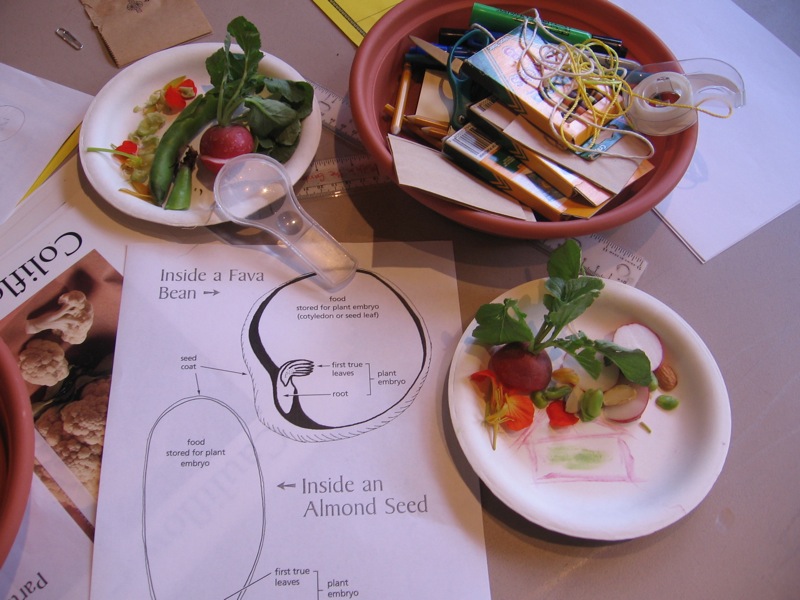
 Presentations at the conference included the Botanical Garden's Botany on your Plate curriculum, which you can now buy at their bookstore. We explored plant parts, and found that you can use radishes as giant pink crayons! We made root mash (like mashed potatoes) from six different root vegetables, and the most popular one was rutabagas!! Apparently rutabagas are becoming endangered because not enough people eat them. I found them delicious.
 In my talk, I also brought up the history of school gardens in the US. Too few of us garden educators know our own history - that during World War I and II school gardens were identified as a major solution to the social issue of the day, national security.
Wartime threatened our food supply, and even Europe was dependent on US-grown food. The US School Garden Army enlisted "soldiers of the soil" to grow food at schools, to increase fruit and vegetable consumption, and to improve the health of the populace. This call that "food will win the war," was incredibly successful. Several million school children grew food in their school gardens, growing 40% of all fruits and vegetables eaten in the US. This was the time in our history when Americans ate the most fruits and vegetables, ever! I learned all this from Rose Hayden-Smith's fascinating work on the US School Garden Army. On her website you can see some of the old propaganda posters, including the one above, calling on children to serve their country in the school garden!
Think we can create such a mass mobilization today? School gardens can have a major impact on many current issues, beyond getting kids to eat more veggies and do better on standardized tests. Can you think big, and think of ways school gardens can make real change in our communities?
 You may be following the worrying news that honey bees are mysteriously disappearing in the US and worldwide, possibly due to a mix of diseases and insecticides. Here in California this seriously threatens our fruit and nut tree crops that depend on bees as pollinators. In fact, Einstein was quoted as saying if the bees go we'd last four years. (The photo at left shows a honey bee swarm we witnessed during the Summer Program at the Garden for the Environment. Click on it to see it bigger - can you see the bees?)
 In our Urban Sprouts' school gardens it is obvious how important pollinators are to the health of our garden ecosystem! This week at June Jordan we reviewed plant reproduction and the important role pollinators play in the lives of many plants. Here is a photo of a daffodil we dissected in order to see all the parts involved in sexual reproduction.
You can see the stamens (male parts), each holding the pollen at their tips, and the pistil in the center (female part) the leads down to the ovary below. We have opened the ovary so you can see the seeds forming inside. The ovary holds the eggs, which once pollinated, grow into seeds. And the ovary swells to become . . . you guessed it, fruit!
Which leads to our favorite saying, how can you recognize a fruit? It has seeds inside!
So the point is that we need pollinators to get the pollen from one flower onto the pistil of another flower. Without pollinators like bees, many of our favorite plants can't produce flowers (or reproduce themselves in order to survive). For examples, think of anything you like to eat that is a fruit or a seed! Apples, pears, almonds, walnuts, tomatoes, squash, corn and even peas need pollination!
A few weeks back I gave a presentation at the Network for a Healthy California Annual Conference in Sacramento. It was a chance to share with other nutrition educators a special strength of Urban Sprouts -- our "Model," something that has theory behind it, has been tested by research, and guides everything that we do. Why is this so special? Let me share a couple of the reasons why we use a program model.
- Not guessing what works – existing theory and the body of knowledge from multiple fields inform our work.
- A recipe for success – what ingredients we must add in order to get the outcomes we desire.
- Evidence of outcomes – Inputs and outcomes are tested by research and evaluation to show impact in the real world.
- A Measurement tool – The model guides all our practices, shows how well we’re doing, and tells us where to make improvements at every step.
Now, you may be wondering, what does this really mean, to have a program model?
Urban Sprouts’ program model was created by Dr. Michelle Ratcliffe. In fact, Dr. Ratcliffe's doctoral research project marked our beginning. The program model demonstrates the links between individual behavior changes that school gardens inspire and the larger impacts on families, schools and communities. The model is based on three elements: a young person’s internal strengths, the school and home settings around her, and her own actions, and, finally, how these three interact to create a healthy or unhealthy community. We don't think of the garden as an input and eating healthy as an output. Instead, the garden (an environment), a person's internal strengths, and a person's behaviors all reinforce each other to make people and the community better.
 Specifically, Urban Sprouts’ school gardens give youth the knowledge and motivation to eat more fruits and vegetables (behaviors), as well as the ability to grow them (affecting the environment). Our programs also teach confidence and leadership (internal strengths) and help youth to identify problems in their communities – like a lack of fresh produce for sale at neighborhood stores – that are barriers to making healthy choices (environment). This program model shows that the garden goes beyond the individual to also have community-level impacts that create broader social change.
In more detail, our program model lays out all the elements that the school garden environment must have in order to actually impact students' internal strengths and their behaviors. These elements fall into three categories: the physical, curricular and social learning environments. Click on this simplified version of model (below) to see it larger.
 Make sense? We have a fun and interesting presentation that lays out the theoretical background and engages the audience with the model in all its detail. If you're interested in learning more, drop us a line and it will help us plan future trainings for the public here in San Francisco.
gbemodel
evaluation