 Help San Francisco State University study the distribution of pollinators in your own backyard. Sign up to be a part of the Great Sunflower Project. Create an account online and you will receive a free packet of wild, native sunflowers (Helianthus annuus) to plant and attract pollinators. Then use the provided datasheet to record the number of pollinators you see. You don’t need to know anything about bees. You just need a willingness to participate and contribute to the project. During your home project you can discuss observations with others online and learn about pollinators. You also don’t need to be located in San Francisco. The Great Sunflower Project is a national project. Sign up today and plant your seeds in your own garden, a community garden or better yet, a school garden!
Tuesday, April 01, 2008
The Great Sunflower Project!
Help San Francisco State University study the distribution of pollinators in your own backyard. Sign up to be a part of the Great Sunflower Project. Create an account online and you will receive a free packet of wild, native sunflowers (Helianthus annuus) to plant and attract pollinators. Then use the provided datasheet to record the number of pollinators you see. You don’t need to know anything about bees. You just need a willingness to participate and contribute to the project. During your home project you can discuss observations with others online and learn about pollinators. You also don’t need to be located in San Francisco. The Great Sunflower Project is a national project. Sign up today and plant your seeds in your own garden, a community garden or better yet, a school garden!


Tuesday, March 25, 2008
Urban Farming Gains Attention
San Francisco Chronicle's March 22nd paper featured a series of articles on urban farming. The many innovative approaches to growing food in an urban setting, such as school gardens, appear to be attracting the attention of city planners. The series ends with an invitation to us readers to share our own thoughts on urban farming with the Chronicle's Kitchen Gardener. Email them and share!
Wednesday, March 19, 2008
Keynote on School Gardens
 I was extremely honored to be asked to give the keynote speech at last Saturday's School Garden conference held by the UC Botanical Garden at Berkeley. The conference theme was successes and best practices, so I shared the Program Model and the story of how Michelle's research study on school gardens led to this framework that guides all Urban Sprouts' work. If you haven't yet visited this amazing botanical garden, go now!
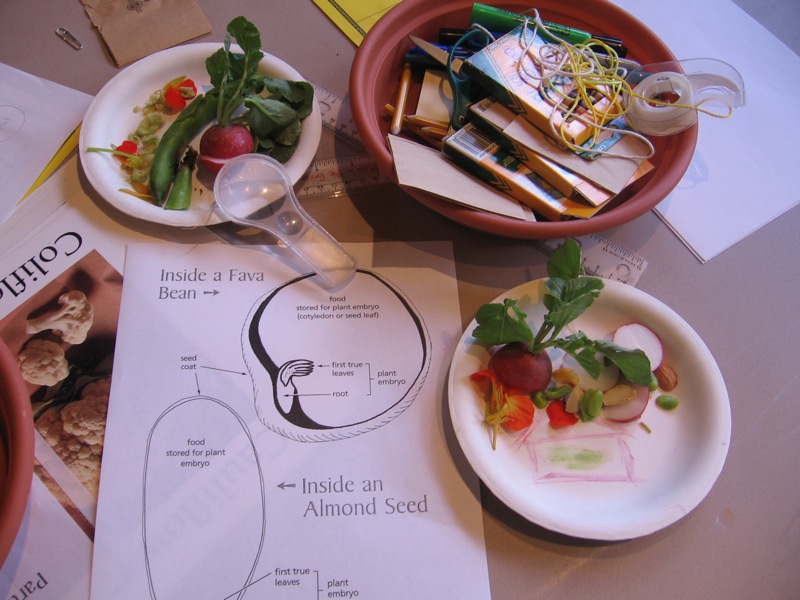 Presentations at the conference included the Botanical Garden's Botany on your Plate curriculum, which you can now buy at their bookstore. We explored plant parts, and found that you can use radishes as giant pink crayons! We made root mash (like mashed potatoes) from six different root vegetables, and the most popular one was rutabagas!! Apparently rutabagas are becoming endangered because not enough people eat them. I found them delicious.
 In my talk, I also brought up the history of school gardens in the US. Too few of us garden educators know our own history - that during World War I and II school gardens were identified as a major solution to the social issue of the day, national security.
Wartime threatened our food supply, and even Europe was dependent on US-grown food. The US School Garden Army enlisted "soldiers of the soil" to grow food at schools, to increase fruit and vegetable consumption, and to improve the health of the populace. This call that "food will win the war," was incredibly successful. Several million school children grew food in their school gardens, growing 40% of all fruits and vegetables eaten in the US. This was the time in our history when Americans ate the most fruits and vegetables, ever! I learned all this from Rose Hayden-Smith's fascinating work on the US School Garden Army. On her website you can see some of the old propaganda posters, including the one above, calling on children to serve their country in the school garden!
Think we can create such a mass mobilization today? School gardens can have a major impact on many current issues, beyond getting kids to eat more veggies and do better on standardized tests. Can you think big, and think of ways school gardens can make real change in our communities?
Monday, March 17, 2008
Build an Urban Bee Garden
A brief but fascinating conversation with Dr. Rollin Coville, a UC Berkeley trained entomologist, led Urban Sprouts to the website for Urban Bee Gardens. For those of you interested in local and native pollinators, check it out! You can learn amazing information about bees such as:
Thank you Dr. Coville forguiding Urban Sprouts to this fun website!
- There are about 25,000 species of bees known worldwide.
- In the U.S. we have almost 4,000 species
- In California slightly more than 1,500 species have been recorded.
- In the East Bay cities of Albany and Berkeley 81 species of bees have been identified from residential neighborhoods.
Thank you Dr. Coville forguiding Urban Sprouts to this fun website!
Wednesday, March 12, 2008
Love your Pollinators!
 You may be following the worrying news that honey bees are mysteriously disappearing in the US and worldwide, possibly due to a mix of diseases and insecticides. Here in California this seriously threatens our fruit and nut tree crops that depend on bees as pollinators. In fact, Einstein was quoted as saying if the bees go we'd last four years. (The photo at left shows a honey bee swarm we witnessed during the Summer Program at the Garden for the Environment. Click on it to see it bigger - can you see the bees?)
 In our Urban Sprouts' school gardens it is obvious how important pollinators are to the health of our garden ecosystem! This week at June Jordan we reviewed plant reproduction and the important role pollinators play in the lives of many plants. Here is a photo of a daffodil we dissected in order to see all the parts involved in sexual reproduction.
You can see the stamens (male parts), each holding the pollen at their tips, and the pistil in the center (female part) the leads down to the ovary below. We have opened the ovary so you can see the seeds forming inside. The ovary holds the eggs, which once pollinated, grow into seeds. And the ovary swells to become . . . you guessed it, fruit!
Which leads to our favorite saying, how can you recognize a fruit? It has seeds inside!
So the point is that we need pollinators to get the pollen from one flower onto the pistil of another flower. Without pollinators like bees, many of our favorite plants can't produce flowers (or reproduce themselves in order to survive). For examples, think of anything you like to eat that is a fruit or a seed! Apples, pears, almonds, walnuts, tomatoes, squash, corn and even peas need pollination!
Thursday, February 28, 2008
Delicious and Meaningful
 I am not easily ruffled by celebrity status. There are strata of celebrity and I am often challenged to distinguish who is who and from what they derive their importance. That said, I actually gawked the other day. I was officially star struck. Not so much by the mere fact of popular status but rather in what this gentleman was choosing to do.
It happened as I was enjoying a slice of heaven, also known as of Shaker Lemon Pie, at Mission Pie. Between mouthfuls (maybe even during), I was engaged in a lively conversation about sustainable food systems of course, when a lean fellow walked through the door. In the midst of conversation, one of my associates discreetly leaned forward and said, “notice the guy that just walked in…but don’t stare.” The man in question was at the counter so I was unable to notice him until he turned to leave. That was when it happened. Mid-sentence I stopped talking and took in the full glory of Mr. Benjamin Bratt.
While I do quite like Mr. Bratt’s acting and naturally, he is beautiful, what truly struck me was that Benjamin Bratt is customer of an establishment that melds the worlds of San Francisco food systems, environmental health, and sustainability with darn good pie. Apparently, he is an ongoing customer of Mission Pie.
Of all the places he could choose to go for a slice of pie in San Francisco, he chooses to support a community driven enterprise that “celebrate farmers, bakers, chefs, and all who work together toward a healthful food system.”* Wow. This is a man of distinguished taste who in one fell swoop is supporting community food systems, sustainable farming and youth leadership…and who, when all is said and done, likes a simple and honest slice of pie.
This is what really got me. A person famous for their action is acting in support of his local community…he cares. For that brief moment I witnessed a meaningful personal act, not a big screen one, that spoke of an inner beauty that matches, if not exceeds, the outer.
Thank you for supporting the cause Mr. Bratt!
Tuesday, February 19, 2008
A Program Model for Garden-based Ed
A few weeks back I gave a presentation at the Network for a Healthy California Annual Conference in Sacramento. It was a chance to share with other nutrition educators a special strength of Urban Sprouts -- our "Model," something that has theory behind it, has been tested by research, and guides everything that we do. Why is this so special? Let me share a couple of the reasons why we use a program model.
Urban Sprouts’ program model was created by Dr. Michelle Ratcliffe. In fact, Dr. Ratcliffe's doctoral research project marked our beginning. The program model demonstrates the links between individual behavior changes that school gardens inspire and the larger impacts on families, schools and communities. The model is based on three elements: a young person’s internal strengths, the school and home settings around her, and her own actions, and, finally, how these three interact to create a healthy or unhealthy community. We don't think of the garden as an input and eating healthy as an output. Instead, the garden (an environment), a person's internal strengths, and a person's behaviors all reinforce each other to make people and the community better.
 Specifically, Urban Sprouts’ school gardens give youth the knowledge and motivation to eat more fruits and vegetables (behaviors), as well as the ability to grow them (affecting the environment). Our programs also teach confidence and leadership (internal strengths) and help youth to identify problems in their communities – like a lack of fresh produce for sale at neighborhood stores – that are barriers to making healthy choices (environment). This program model shows that the garden goes beyond the individual to also have community-level impacts that create broader social change.
In more detail, our program model lays out all the elements that the school garden environment must have in order to actually impact students' internal strengths and their behaviors. These elements fall into three categories: the physical, curricular and social learning environments. Click on this simplified version of model (below) to see it larger.
 Make sense? We have a fun and interesting presentation that lays out the theoretical background and engages the audience with the model in all its detail. If you're interested in learning more, drop us a line and it will help us plan future trainings for the public here in San Francisco.
gbemodel
evaluation
- Not guessing what works – existing theory and the body of knowledge from multiple fields inform our work.
- A recipe for success – what ingredients we must add in order to get the outcomes we desire.
- Evidence of outcomes – Inputs and outcomes are tested by research and evaluation to show impact in the real world.
- A Measurement tool – The model guides all our practices, shows how well we’re doing, and tells us where to make improvements at every step.
Urban Sprouts’ program model was created by Dr. Michelle Ratcliffe. In fact, Dr. Ratcliffe's doctoral research project marked our beginning. The program model demonstrates the links between individual behavior changes that school gardens inspire and the larger impacts on families, schools and communities. The model is based on three elements: a young person’s internal strengths, the school and home settings around her, and her own actions, and, finally, how these three interact to create a healthy or unhealthy community. We don't think of the garden as an input and eating healthy as an output. Instead, the garden (an environment), a person's internal strengths, and a person's behaviors all reinforce each other to make people and the community better.
 Specifically, Urban Sprouts’ school gardens give youth the knowledge and motivation to eat more fruits and vegetables (behaviors), as well as the ability to grow them (affecting the environment). Our programs also teach confidence and leadership (internal strengths) and help youth to identify problems in their communities – like a lack of fresh produce for sale at neighborhood stores – that are barriers to making healthy choices (environment). This program model shows that the garden goes beyond the individual to also have community-level impacts that create broader social change.
In more detail, our program model lays out all the elements that the school garden environment must have in order to actually impact students' internal strengths and their behaviors. These elements fall into three categories: the physical, curricular and social learning environments. Click on this simplified version of model (below) to see it larger.
Make sense? We have a fun and interesting presentation that lays out the theoretical background and engages the audience with the model in all its detail. If you're interested in learning more, drop us a line and it will help us plan future trainings for the public here in San Francisco.gbemodel
evaluation
Tuesday, January 29, 2008
SF, Take our School Food Survey!
If you are a San Francisco student, parent, teacher, principal, community organization, or taxpayer, your voice is needed on SF school food! Take our short survey now.
In 2003, San Francisco’s public schools created a ground-breaking Wellness Policy that led the way to boldly removing vending machines and junk food from our city’s public schools. Since then, federal mandates have required that all districts create such Wellness Policies, adding power to the messages contained in ours.
Now, we have an opportunity to further raise the bar and to articulate what truly healthy schools for our city’s youth would look like! We have put together some possible additions to the SFUSD Wellness Policy—ideas gathered from other schools—including: encouraging more nutrition education through school gardens, more fresh produce that is locally grown, more recycling in the cafeterias, more opportunities for physical activity, and more connections between what students learn about healthy eating and the foods we offer at school. We want to connect the dots between a healthy environment, healthy youth, and our city’s schools!
We’ve created a survey that asks your priorities in these areas, including drafts of sample policies. These are just rough ideas so we need all the input we can get. We will share your priorities with the district’s Student Nutrition and Physical Activity Committee for consideration in revisions of the policy.
Click Here to take our Survey
Please take the survey as soon as possible – by this Friday or at least Monday if you can!
For some background on our involvement in this work, please read About Urban Sprouts: History.
In 2003, San Francisco’s public schools created a ground-breaking Wellness Policy that led the way to boldly removing vending machines and junk food from our city’s public schools. Since then, federal mandates have required that all districts create such Wellness Policies, adding power to the messages contained in ours.
Now, we have an opportunity to further raise the bar and to articulate what truly healthy schools for our city’s youth would look like! We have put together some possible additions to the SFUSD Wellness Policy—ideas gathered from other schools—including: encouraging more nutrition education through school gardens, more fresh produce that is locally grown, more recycling in the cafeterias, more opportunities for physical activity, and more connections between what students learn about healthy eating and the foods we offer at school. We want to connect the dots between a healthy environment, healthy youth, and our city’s schools!
We’ve created a survey that asks your priorities in these areas, including drafts of sample policies. These are just rough ideas so we need all the input we can get. We will share your priorities with the district’s Student Nutrition and Physical Activity Committee for consideration in revisions of the policy.
Click Here to take our Survey
Please take the survey as soon as possible – by this Friday or at least Monday if you can!
For some background on our involvement in this work, please read About Urban Sprouts: History.
Subscribe to:
Posts (Atom)


