Tuesday, April 18, 2006

First Sunny Day Photos - Burbank

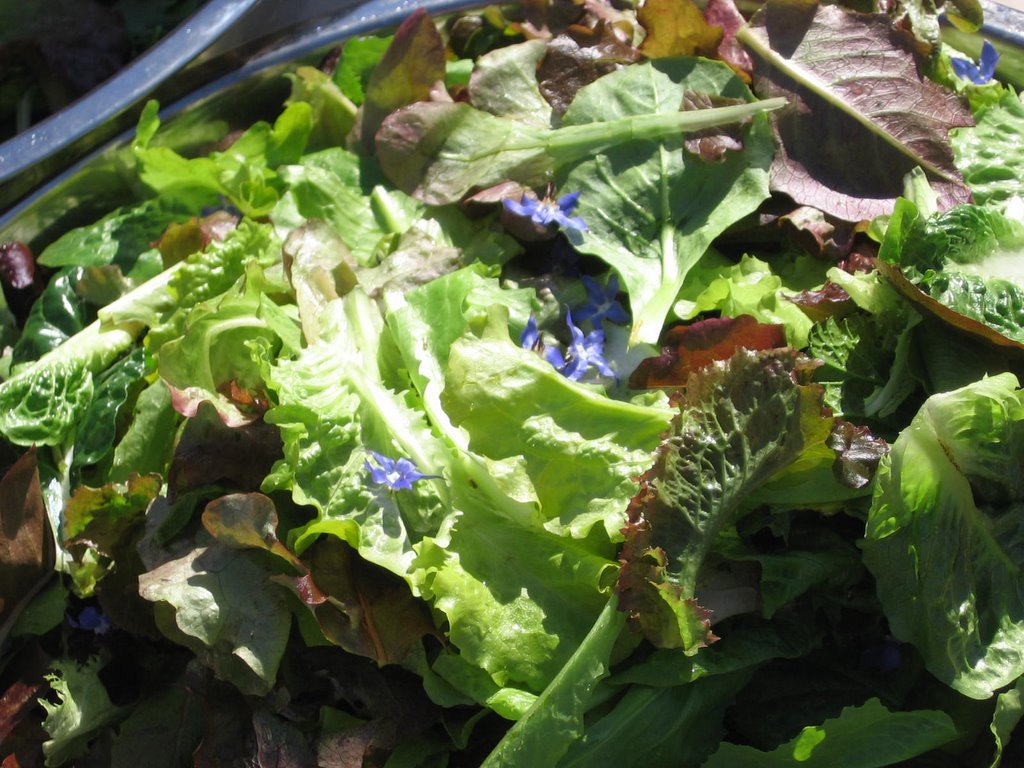
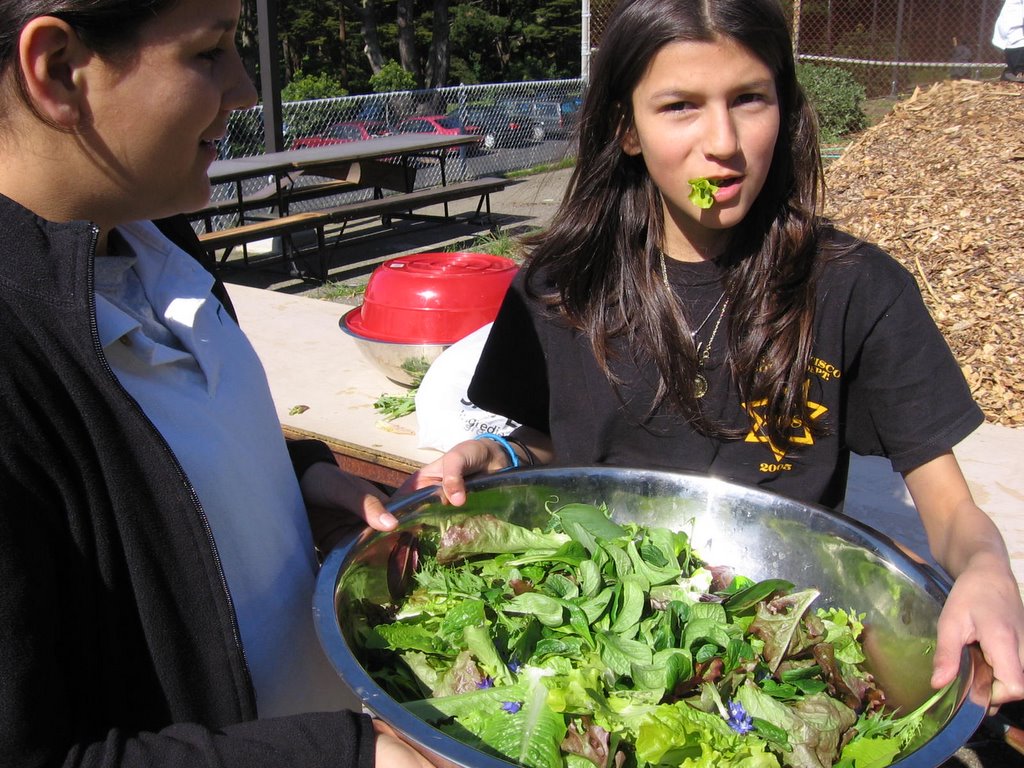
Welcome to literally the first sunny day we've had for gardening at Burbank this spring. It has been so dreary lately. I think these photos taken by the students in Ms. DeSnoo's 3rd period class capture our day quite well.

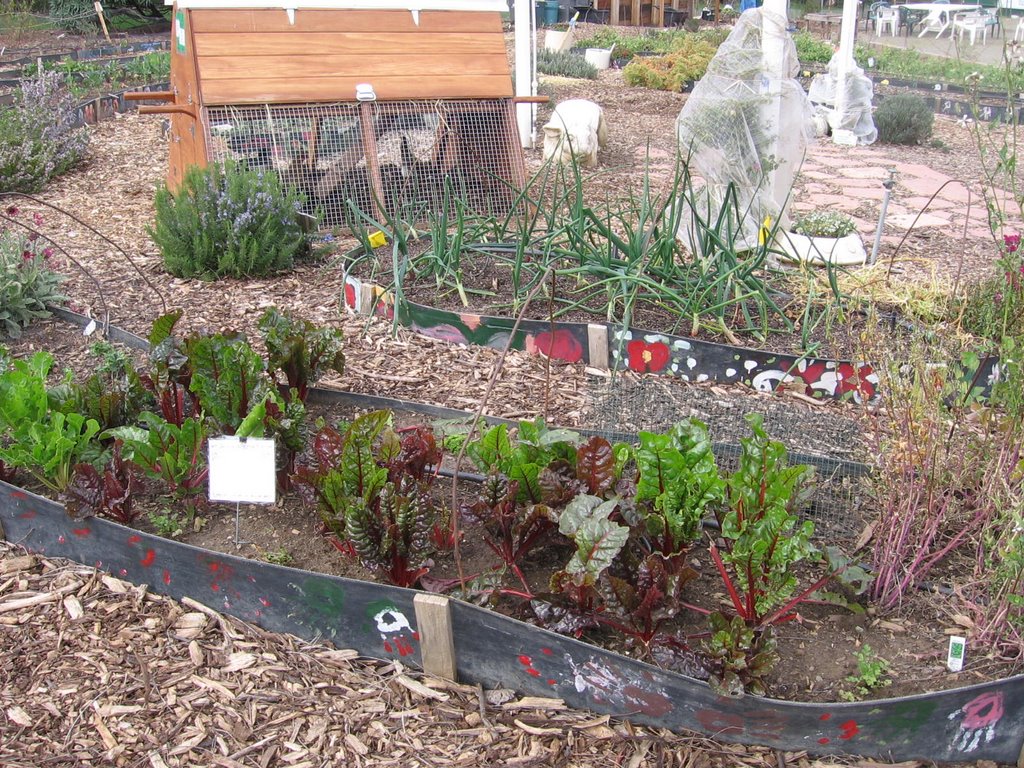
Above: the new sprouts
Below: the wild ones

The workers:


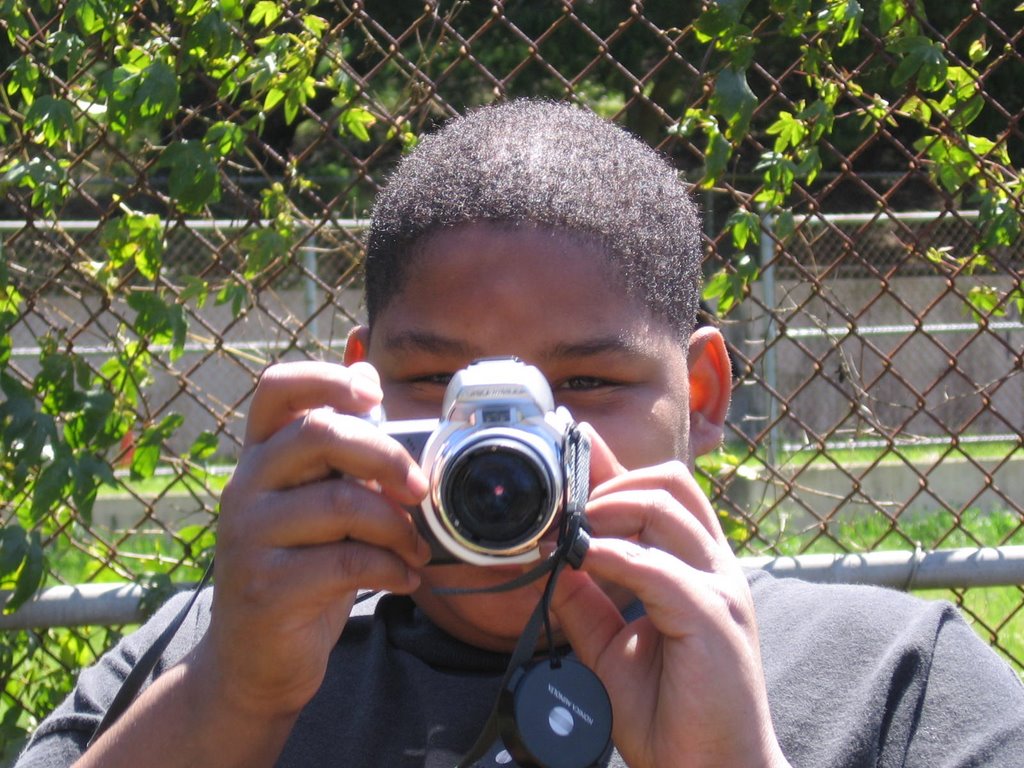
The photographer(s):


Friday, April 14, 2006

Five Resources for School Garden Educators

My apologies to Britt! It’s taken me a month and a half, but I’m finally responding to this meme Britt tagged me for, to answer this question:

"What five resources - online or otherwise - would you point people to, if you wanted to give them an entry into your field of expertise?"

To become a School Garden Educator I have had to carve out my own path. I found no field of expertise to follow. The "field" is nebulous, a little here a little there, but I think now it is really taking shape.

My approach was combining several related fields, like
sustainable agriculture, youth development, education and nonprofits, but I found some serious disconnection between them. Not to mention between the goals and standards for public education and the real, holistic needs of young people as they grow up.

I believe youth need to grow up connected to nature the same way that plants need to grow connected to healthy soil, full of life, not just synthesized petro-based chemicals.

Here are some of the resources I would recommend for aspiring School Garden Educators.

The new website of the California School Garden Network seems to be the most comprehensive resource so far, with lists of curriculum, contacts, trainings, funding opportunities, and policy and research citations.

Occidental Arts & Ecology Center School Garden Training, Sonoma, CA
This is an incredible 5-day training at an organic garden where you learn the basics of horticulture plus the nitty gritty of starting and sustaining a school garden. The garden basics are like a VERY condensed form of what you get at the UCSC Farm & Garden Apprenticeship, but for school garden educators. SFUSD schools serving low-income communities can go for free.

Gardening and Composting Educator Training Program (GCETP or “the Get Up Class” for short)
This training based out of San Francisco’s Garden for the Environment teaches the basics of gardening and composting (geared for urban home and community gardens) and how to teach them to others. Many of our BEST Urban Sprouts volunteers are graduates of this excellent program.

Community Network for Youth Development (CNYD) Learning Network
The Learning Network is a four month program that makes Youth Development theory real and tangible, a strong basis and justification for our work. I think we should all be thinking about and using theory to support our work, from frontline youth workers to teachers to directors—it's not just for academics!

And stay tuned for the Garden-based Education theoretical model that the amazing Michelle M. Ratcliffe is developing with support from Urban Sprouts.

And, some good books! (OK, this is more than 5)

My path to garden-based education started in two places: on a farm in rural Pennsylvania and alone in the darkest, dustiest, most hidden stacks of my school library. These classic books and writers had a huge impact on me as I plotted my career path.

The One-Straw Revolution by Masanobu Fukuoka
A Japanese scientist “converts” from scientific farming to natural farming, teaching that nature is a more efficient farmer than western science, because it’s about utilizing interconnections instead of dominating the soil with chemicals and machines.

Vandana Shiva
Again, an Indian scientist leaves the “religion” of western science to learn from nature rather than objectification in the laboratory. She shows how rural women are the best scientists, because they use their emotions and intuition –yeah, ladies! She has a lot of great books. I like Staying Alive: Women, Ecology & Development and her best title Monocultures of the Mind!

Miguel Altieri & Agroecology
Altieri’s book Agroecology is great. He’s from Chile, and I’ll never forget when I heard him speak and he said that this big Chilean island called Chiloe has more than 300 different varieties of potatoes. All on ONE island! Now that’s diversity! He writes about many traditional/indigenous Latin American farming techniques.

Training for Transformation by Anne Hope and Sally Timmel
A classic training handbook for participatory education based on Paulo Freire’s theories. Formal education so often reinforces power and oppresion, teaching that only the teacher knows best. Students have a lot to teach teachers, too!!

Since we talked today about professional development at our Rising Leaders Fellowship today, I'm tagging Sangita, Sele and Carrie to give five resources related to the inspiring work they do.


Thursday, April 06, 2006

How much Sugar in my Drink?

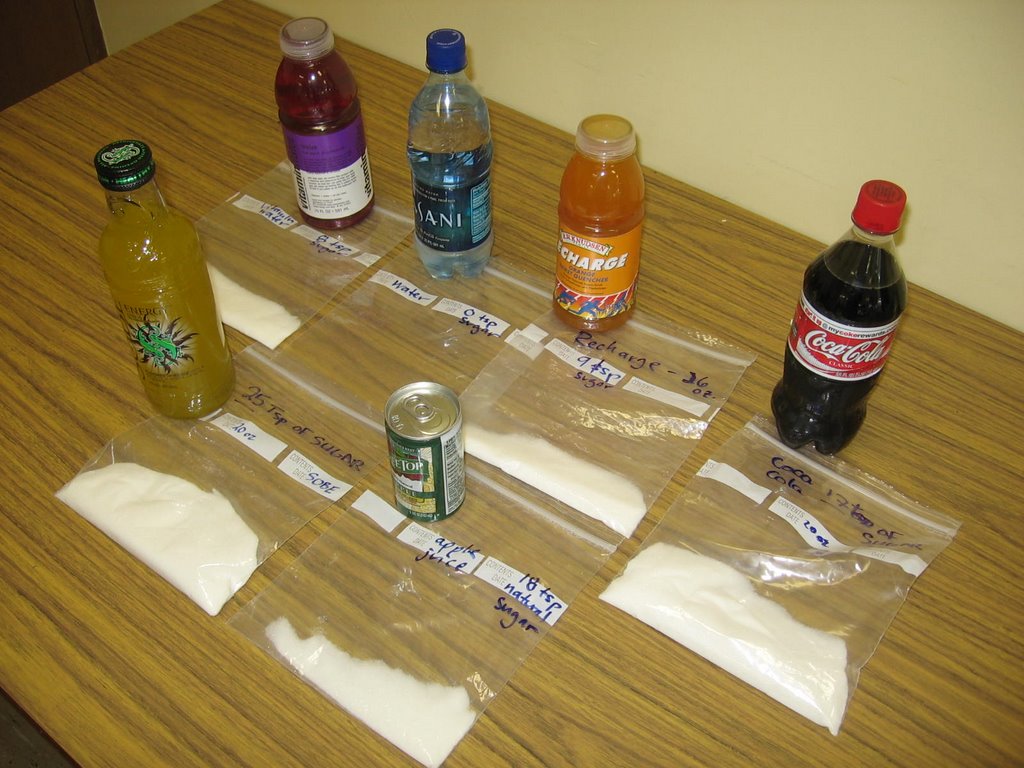
Today in Ms. Boggess’s 7th grade Peer Resources class at Burbank, we compared the amount of sugar in different kinds of beverages. In order to compare we took four steps:
  1. We read Nutrition Facts on each bottle and found the grams of sugar in one serving size, or 8 oz.
  2. We calculated how many servings were in one bottle. Most bottles were 20 oz, so we used that number, and got the total grams of sugar in one bottle.
  3. We weighed one teaspoon of sugar (4 grams) and calculated how many teaspoons of sugar are in one bottle.
  4. We measured out the number of teaspoons into a plastic baggie for each beverage, so we could SEE the difference!
Here are our totals, for teaspoons of sugar in one 20 oz bottle of different beverages:
Water – 0 tsp
V8 – 6 tsp
Vitamin Water – 8 tsp
Sports drink – 9 tsp
Apple juice – 18 tsp
Coke – 17 tsp
SoBe Citrus drink – 25 tsp
Sugar Limit for one entire day: 48 g or 12 tsp

Then we thought about what it would be like to eat the bag of 25 teaspoons of sugar. Yuck.

Then we talked about a few things. One, would you rather eat natural sugar that comes straight from an apple, no sugar added, instead of a coke that is full of added sugar? Or diet soda, filled with fake, chemical sugar?!

Last, we thought about what happens to you if you eat more than 12 teaspoons of sugar per day. We though you would gain lots of weight, and have trouble in class because you’d feel really hyper and then later you’d feel sick, tired and have a headache.

At the end of class we made delicious smoothies!

Tuesday, April 04, 2006

Schools Represent at SF Flower Show

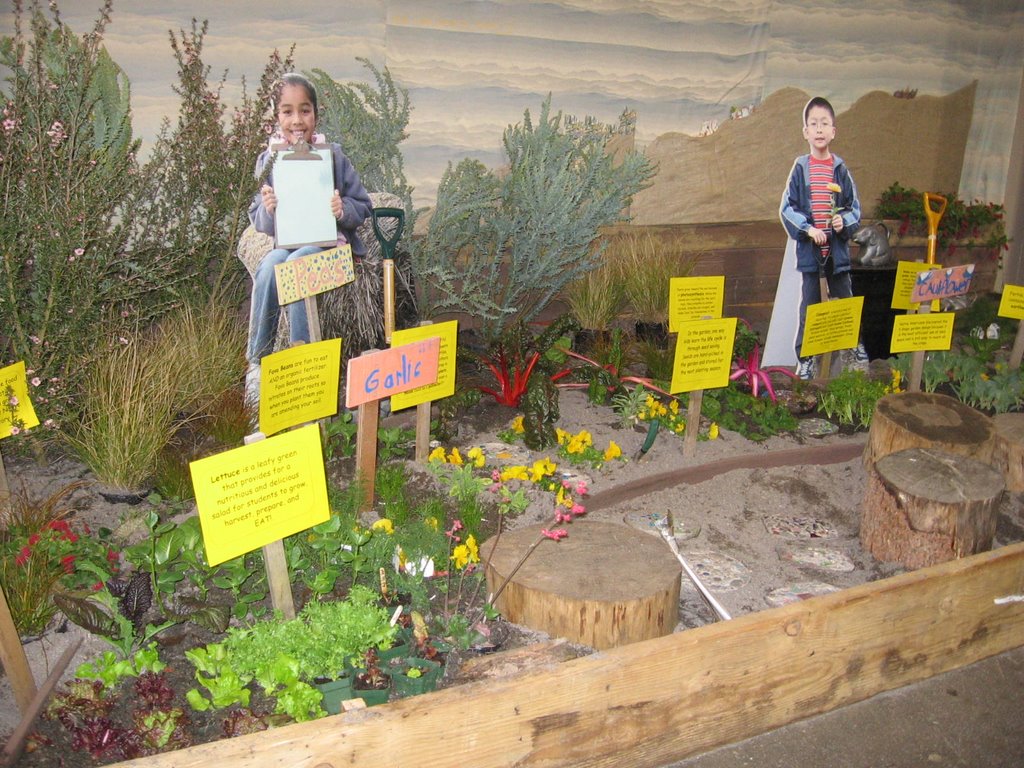
Congrats to all the SFUSD school and SF Green Schoolyard Alliance gardeners who created this amazing garden vignette for the SF Flower & Garden Show, held March 15-19 this year.

It was so great to have the schools represented at this big, high profile show. And our district Educational Gardens Director, Arden Bucklin-Sporer, gave a presentation that was an inspirational pep talk for all of us school gardeners. Great job everyone!

Also, the SF Green Schoolyard Alliance has just produced a beautiful school garden resource directory, which you can download from SF Beautiful.


Thursday, March 30, 2006

The Meatrix II: Revolting

Be very excited! Today the new Meatrix II premiered! This sequel to the original Meatrix takes you into the "matrix" of factory farms to show what's really going on. The animated stars, a pig, cow and chicken, ask you to join the resistance and help them save family farms and healthy meat & dairy.

Both movies are great for schools and youth, to watch and learn why we should all support family farms. The interactive Meatrix website has LOTS of facts about agribusiness and lists of sustainable farms and dairies in your zip code.

The Meatrix sez: "Did you know that over 70% of all antimicrobials used in the US go to farm animals? This leads to antibiotic resistant bacteria which affect us." Check it out!


Friday, March 17, 2006

Experience & Transformation in Ed

The weekend of March 4-5 I presented at the Western Region Association of Experiential Education Conference at Camp Arroyo in Livermore, CA. (pic of Camp Arroyo's children's garden) "Experiential Ed" seems to be generally marketed to the outdoor, adventure type crowd. I have to admit I was wary of the different expectations of programs for suburban California kids climbing mountains compared to our urban reality where just mud itself is a bit scary. I wasn't sure I'd fit in with this group of educators.

And my fears were realized. But also they were transformed, which was the theme of the conference. Two workshops really inspired me. The first was led by Melissa Meyer, who uses experiential therapy in her work with youth and their families. In my favorite activity, she asked us to make envelopes and notes out of colored construction paper. On the outside of the envelope we wrote things about ourselves that other people can see. On the notes we wrote things that we don't often share but keep inside. We each decorated our precious little envelopes, and by the end we felt safe enough to share some of our inside thoughts. One I wrote was, "My grandma's stories give me the most hope."

The second workshop I loved was presented by a group of students and their teacher, Rona Zollinger, from the Environmental Studies Academy in Martinez, CA. The students shared their experiences of frustration and sometimes failure in traditional high schools, and of moving to a continuation high school that uses place-based and transformative learning to help youth create a meaningful space to learn, grow, and improve their community. The students and Rona were amazing and inspiring. There were teary eyes all around by the end!

Last, I presented my Urban Sprouts workshop! I was very nervous, but it went great. I even had two participants tell me it was their best workshop of the conference! Michelle and I put together an experiential workshop to engage people with the theoretical model she has created, which drives all of Urban Sprouts' programming. Participants shared stories of transformation and read a great children's story of youth-led community change: The Gardener, by Sarah Stewart. Our training is ready to hit the road, so readers out there, let me know of any opportunities! The model can really help to shape strong garden-based education programs.


Monday, February 27, 2006

School Salad Harvest, part 1

Tuesday was our practice Salad Day at Burbank M.S. For this round we did minimal school publicity, just a handful of posters made by Mr. Perez’s students and hung up around school by Ms. Keenan’s students. Perez’s and DeSnoo’s 2nd period groups, and Keenan’s 4th period class harvested all the lettuce heads and as much loose salad mix as they could, washed it, dried it in the salad spinner, checked through all the leaves and removed any yucky stuff, and presented beautiful, fresh, organic, garden-grown salad during lunch period. We set up a table in the cafeteria, with tablecloths and crepe paper decorations, and a handful of students sat at the table helping to serve the salad and eating it. Lori and I passed out salads to students sitting at tables throughout the cafeteria, and our table was swarmed with students and teachers coming to eat their salad. Many came back for seconds and thirds! Teachers even took home a few plastic baggies of the leftovers. Lunch groups, like Ms. Valdez’s girls group, took enough for their members. The students and teachers ate ALL the salad we had harvested. We had two huge silver bowls of salad—I’d estimate 6-8 lbs at least.

Dr. Ignacio (School Assistant Principal) came by during lunch and said to me, “Never, not once in my entire career as an educator has this happened before, but this year three times students have seen me eating my apple and have asked for some fruit to eat.” For the first time ever for many students, that apple for the teacher has a new meaning.


NYT Op-Ed: Food at School

This Op-Ed piece by Alice Waters appeared in the New York Times on Friday. Her program, the Edible Schoolyard, is different from Urban Sprouts in many ways, but the core is the same: through school garden experiences, young people are inspired to make real changes in their eating behaviors.
IT'S shocking that because of the rise in Type 2 diabetes experts say that the children we're raising now will probably die younger than their parents — the result of a disease that is largely preventable by diet and exercise. But in public schools these days, children all too often are neither learning to eat well nor to exercise . . .

[At the Edible Schoolyard] we're not forcing [children] to eat their vegetables; we're teaching them about the botany and history of those vegetables. We're not scaring them with the health consequences of their eating habits; we're engaging them in interactive education that brings them into a new relationship with food. Nothing less will change their behavior . . .

. . . when a healthy lunch is a part of a class that all children have to take, for credit — and when they can follow food from the garden to the kitchen to the table, doing much of the work themselves — something amazing happens. The students want to taste everything. They get lured in by foods that are beautiful, that taste and smell good, that appeal to their senses. When children grow and prepare good, healthy food themselves, they want to eat it, and, what's more, they like this way of learning.

We need a revolution, a delicious revolution, that will induce children — in a pleasurable way — to think critically about what they eat.

—Alice Waters