Thursday, March 30, 2006

The Meatrix II: Revolting

Be very excited! Today the new Meatrix II premiered! This sequel to the original Meatrix takes you into the "matrix" of factory farms to show what's really going on. The animated stars, a pig, cow and chicken, ask you to join the resistance and help them save family farms and healthy meat & dairy.

Both movies are great for schools and youth, to watch and learn why we should all support family farms. The interactive Meatrix website has LOTS of facts about agribusiness and lists of sustainable farms and dairies in your zip code.

The Meatrix sez: "Did you know that over 70% of all antimicrobials used in the US go to farm animals? This leads to antibiotic resistant bacteria which affect us." Check it out!


Friday, March 17, 2006

Experience & Transformation in Ed

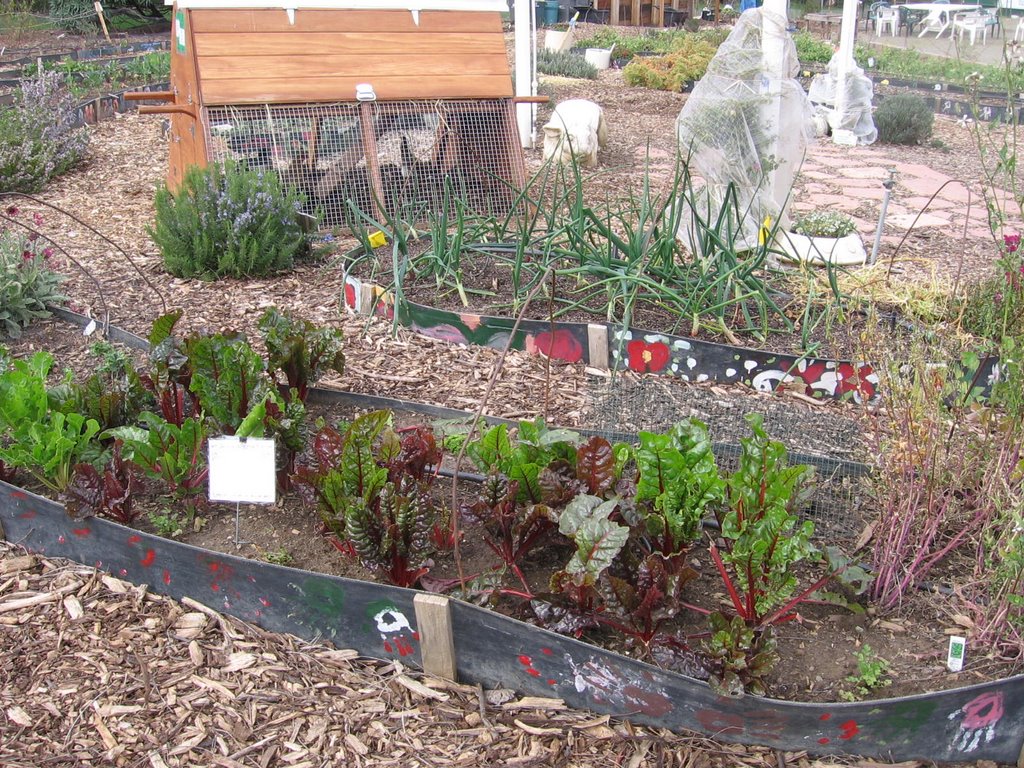
The weekend of March 4-5 I presented at the Western Region Association of Experiential Education Conference at Camp Arroyo in Livermore, CA. (pic of Camp Arroyo's children's garden) "Experiential Ed" seems to be generally marketed to the outdoor, adventure type crowd. I have to admit I was wary of the different expectations of programs for suburban California kids climbing mountains compared to our urban reality where just mud itself is a bit scary. I wasn't sure I'd fit in with this group of educators.

And my fears were realized. But also they were transformed, which was the theme of the conference. Two workshops really inspired me. The first was led by Melissa Meyer, who uses experiential therapy in her work with youth and their families. In my favorite activity, she asked us to make envelopes and notes out of colored construction paper. On the outside of the envelope we wrote things about ourselves that other people can see. On the notes we wrote things that we don't often share but keep inside. We each decorated our precious little envelopes, and by the end we felt safe enough to share some of our inside thoughts. One I wrote was, "My grandma's stories give me the most hope."

The second workshop I loved was presented by a group of students and their teacher, Rona Zollinger, from the Environmental Studies Academy in Martinez, CA. The students shared their experiences of frustration and sometimes failure in traditional high schools, and of moving to a continuation high school that uses place-based and transformative learning to help youth create a meaningful space to learn, grow, and improve their community. The students and Rona were amazing and inspiring. There were teary eyes all around by the end!

Last, I presented my Urban Sprouts workshop! I was very nervous, but it went great. I even had two participants tell me it was their best workshop of the conference! Michelle and I put together an experiential workshop to engage people with the theoretical model she has created, which drives all of Urban Sprouts' programming. Participants shared stories of transformation and read a great children's story of youth-led community change: The Gardener, by Sarah Stewart. Our training is ready to hit the road, so readers out there, let me know of any opportunities! The model can really help to shape strong garden-based education programs.


Monday, February 27, 2006

School Salad Harvest, part 1

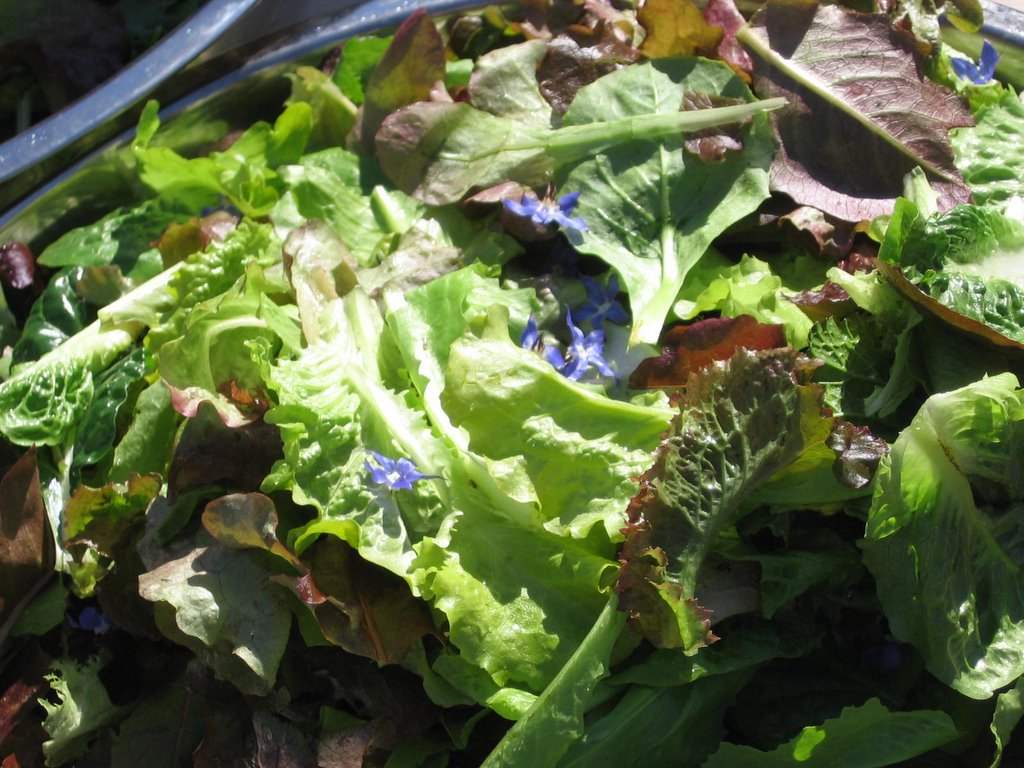
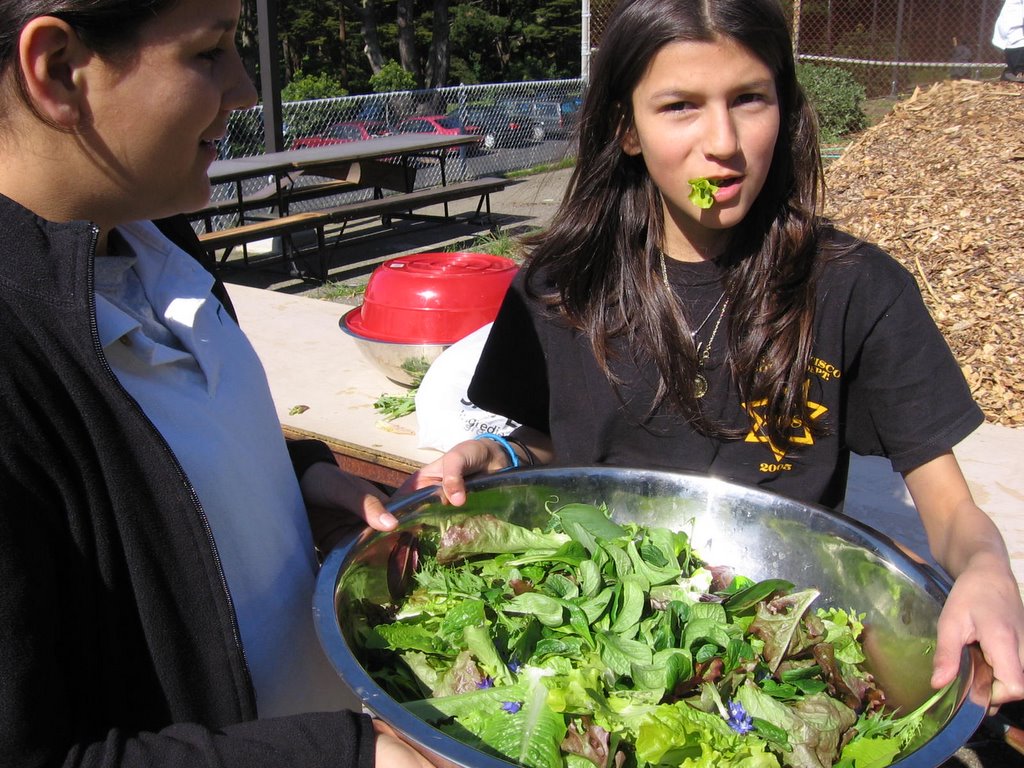
Tuesday was our practice Salad Day at Burbank M.S. For this round we did minimal school publicity, just a handful of posters made by Mr. Perez’s students and hung up around school by Ms. Keenan’s students. Perez’s and DeSnoo’s 2nd period groups, and Keenan’s 4th period class harvested all the lettuce heads and as much loose salad mix as they could, washed it, dried it in the salad spinner, checked through all the leaves and removed any yucky stuff, and presented beautiful, fresh, organic, garden-grown salad during lunch period. We set up a table in the cafeteria, with tablecloths and crepe paper decorations, and a handful of students sat at the table helping to serve the salad and eating it. Lori and I passed out salads to students sitting at tables throughout the cafeteria, and our table was swarmed with students and teachers coming to eat their salad. Many came back for seconds and thirds! Teachers even took home a few plastic baggies of the leftovers. Lunch groups, like Ms. Valdez’s girls group, took enough for their members. The students and teachers ate ALL the salad we had harvested. We had two huge silver bowls of salad—I’d estimate 6-8 lbs at least.

Dr. Ignacio (School Assistant Principal) came by during lunch and said to me, “Never, not once in my entire career as an educator has this happened before, but this year three times students have seen me eating my apple and have asked for some fruit to eat.” For the first time ever for many students, that apple for the teacher has a new meaning.


NYT Op-Ed: Food at School

This Op-Ed piece by Alice Waters appeared in the New York Times on Friday. Her program, the Edible Schoolyard, is different from Urban Sprouts in many ways, but the core is the same: through school garden experiences, young people are inspired to make real changes in their eating behaviors.
IT'S shocking that because of the rise in Type 2 diabetes experts say that the children we're raising now will probably die younger than their parents — the result of a disease that is largely preventable by diet and exercise. But in public schools these days, children all too often are neither learning to eat well nor to exercise . . .

[At the Edible Schoolyard] we're not forcing [children] to eat their vegetables; we're teaching them about the botany and history of those vegetables. We're not scaring them with the health consequences of their eating habits; we're engaging them in interactive education that brings them into a new relationship with food. Nothing less will change their behavior . . .

. . . when a healthy lunch is a part of a class that all children have to take, for credit — and when they can follow food from the garden to the kitchen to the table, doing much of the work themselves — something amazing happens. The students want to taste everything. They get lured in by foods that are beautiful, that taste and smell good, that appeal to their senses. When children grow and prepare good, healthy food themselves, they want to eat it, and, what's more, they like this way of learning.

We need a revolution, a delicious revolution, that will induce children — in a pleasurable way — to think critically about what they eat.

—Alice Waters


Thursday, February 23, 2006

Wriggling Worms

Our worm bottle project at Ida B. Wells is going really well. Last week the students made worm bottles—they turned plastic water bottles into cozy worm houses. First they had to cut off the tops and poke holes in the bottles to provide air for the worms. Then they filled the bottle with layers of shredded newspapers and chunks of vegetable scraps. They sprayed the newspaper with water to provide a moist environment for the worms. While doing this, we got to talk about how much moisture the worms need and why—they breathe through their skin, which has to be wet in order for them to breathe. We also talked about the newspaper bedding, which makes a comfortable environment for them but is also a food source. Worms eat paper?? Yes! Paper is made of plant matter (wood pulp) and ours is printed with soy ink! So it’s healthy for worms to eat. After building the layers, we opened the can of worms (ha ha) and the students put on some rubber gloves.

Then the fun really began. I was so amazed at how interested the students were in touching and examining the worms! There was only ONE single comment of gross-ness! They dug right in, poking around and looking for the big ones and little ones. We looked at a big red worm with a visible clitellum, the ring that the worm slips off to fill with eggs, making a cocoon. Several students exclaimed, “I want to see the pregnant worm!” Many discussions of worm sexuality followed—worms are hermaphrodites but they do need a partner to reproduce! We could even see lots of baby worms crawling around. The students were really mesmerized.

The best was today, when we opened up the bottles to take notes on how they have changed since last week. The students sprayed them with more water at least once in the meantime, and stored them in a dark and warm part of the classroom away from windows. Today was so great! Everyone opened up their bottles, and many emptied them onto newspaper to really see the contents. The worms looked even fatter and redder, and there were lots of little babies. The contents of the bottle were all mixed up now, no longer neat layers of paper and vegetables, but a mass of worm castings that look like black soil, pieces of paper and vegetables, and plenty of mold as well. The students looked at everything, wrote down what they saw, and then cleaned up their little worm homes. They took out some of the moldy bits, re-wetted the paper, and added new fresh food scraps. They packed their bottles back up, wrapped in dark-colored construction paper, and tucked them back into their cozy corner.

Today especially, checking on the worms a week later, the students were really observing what conditions make the worms happiest. They decided that fat, moist, red, and reproducing worms meant they were happy. They noticed the moisture levels, the amount of food, and the darkness in “happier” bottles and tried to make their own bottles healthier worm environments. We even looked at some “pregnant” and baby worms under the microscope. So slimy and cool!

I got this activity from Nutrition to Grow On, a garden-based curriculum created by Jennifer Morris & Sheri Zidenberg-Cherr, which you can order from the California Dept of Education. Also see links “For your Own School Garden” in the sidebar of this blog.


Tuesday, February 07, 2006

Mapping our Waste Stream

Yesterday we had a great day at June Jordan School for Equity in our garden-based environmental justice elective, called the Green Revolution, and taught by Ms. Huang. We completed the first step of our new campaign to reduce school waste through recycling & composting. The students are conducting youth-led action research, in order to assess the level of recycling of waste currently going on at school, to figure out what needs to be done to improve it, and to create a school-wide campaign to make that change.

Resources we’ve drawn on so far include SF Environment’s Food to Flowers school recycling program, and the Youth Leadership Institute’s youth-led action research & planning curriculum.

Last week the students collected data on all the trash and recyclables being thrown away in every part of the school. Yesterday they put them together on a map of the school, to see where and how trash is moving. Next step, they’ll ask questions about who is recycling and why, and they’ll survey and interview youth and adults at school about their opinions and behaviors regarding recycling & composting.


Meanwhile, the students are caring for red wriggler worms in the classroom, to get to know them up close and personal before starting a worm bin.


Monday, January 30, 2006

Abby Interviewed by Net2

Check out this interview with me about the Urban Sprouts blog and the benefits of blogging to small nonprofits.

The interview was done by Marshall of NetSquared, a project dedicated to helping nonprofits take advantage of emerging technology. A big thanks to Britt Bravo, also of NetSquared, who helped me to get started and see the benefits of blogging in the first place!


Wednesday, January 25, 2006

Guest Chefs visit Burbank M.S.

Today guest chef-educators Megan and Rania came from NextCourse to do a lesson. We had a great day! As Megan led the lesson, I had fun getting to sit back and be part of the crowd, helping students to stay quiet and participate, but also getting to chat and joke with them while the group was eating and learning together. Getting to enjoy my connection with the students, rather than being the ringmaster directing traffic up on stage. Especially with students who have stayed for after school, I appreciated how familiar they are with me, trusting me. Today I could give them individualized roles, when individuals had trouble with the group assignment, and be thoughtful and careful because I wasn’t under the stress of having to manage the whole group of 30 alone. Having over 6 adults made the biggest difference.

Megan did a great lesson, focusing on the difference between whole foods and processed foods. She had examples of both for students to see, like potatoes and chips, real oats and cereal, milk and ice cream. Then she led an exercise that led students along the path an orange takes from a local farm to homemade juice, versus from an overseas farm to the processing plant to bottled orange juice in the store. The students did a great job of paying attention and participating.

First, Megan asked the group about the garden, about what they’ve been growing there and how they’ve been growing it. It was great to see how much the students had to say. They talked about how they have improved the soil with compost and wood chips, and by weeding and watering. They mentioned all kinds of critters we’ve seen (snails, gophers, worms) and foods we’ve tasted (mint, strawberries, potatoes).

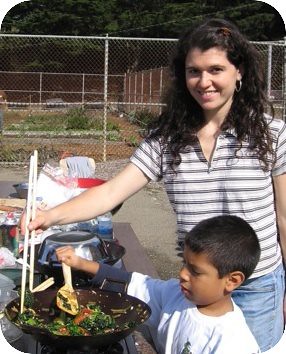
Lastly, Megan and Rania led the students in squeezing orange juice and mixing up salsa from fresh ingredients. While the students helped making food, they told Rania about the foods they’ve made. Tyrell told her how he made the French fries at the garden party. Before we went outside he even asked me, “Are we going to cook in a wok?” Megan also remarked that they have learned so much, about the garden and the food in it, and that all the being, doing and connecting in the garden teach much more than words can get across.

It’s amazing to see the evidence in action. These are young people who, without thinking twice, buy chips and soda at the store every day. These same students are talking all about organic food, about cooking with woks, harvesting potatoes and mint, and getting exciting about it. This is clearly a shift in attitudes and beliefs, and in preferences. They are tasting and eating whole foods. They haven’t yet made the change in behavior overall, but they make smaller choices every day when they choose to eat from the garden and tell others about it. Megan said one of her students made his own choice to throw out his bag of Cheetos when he came to her class.

As teachers, we worry so much that the students are getting “enough” curriculum on every subject we want them to learn all about. But the most significant thing I ever learned in school was how to learn for myself: how to think, how to ask questions, and how to find out the answers myself. In the garden, students watch a plant grow and fruit, or watch a plant die as it gets dragged down a gopher hole or munched by snails. These things teach the students so much more than any curriculum, no matter how interactive.